Succession Planning Is Often Misunderstood
For many business owners, succession planning is framed as a checklist: identify a successor, set a date, document a plan.
That framing misses the reality.
Succession planning isn’t difficult because owners don’t understand its importance. It’s difficult because it touches identity, uncertainty, family dynamics, and control — all while competing with the daily demands of running a business.
The most effective owners approach succession planning gradually and intentionally — one that creates flexibility long before decisions are forced. This article will show what that looks like in practice:
TOPICS COVERED:
- Why Succession Planning Is Often Misunderstood
- Ten Practical Steps to Build a Succession Plan
- Succession Planning: Not Just an Exit Strategy
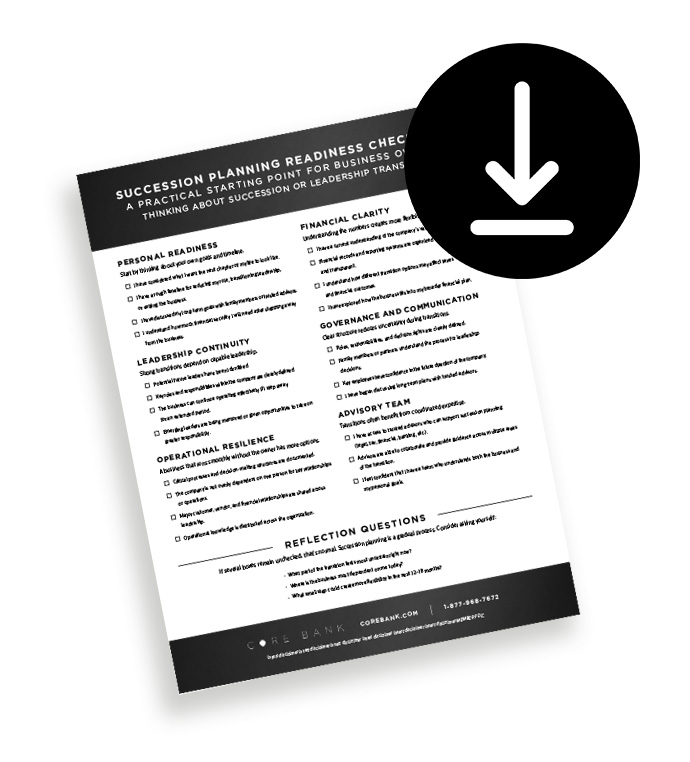
- FREE Downloadable Succession Planning Checklist
Ten Practical Steps
1) Start Before You Feel “Ready”
Early work buys flexibility. It gives you time to test scenarios, build talent, and adjust course as markets or family circumstances change. Waiting compresses options and forces decisions on someone else’s timeline. . Many owners delay succession planning not because they’re avoiding responsibility, but because the business still needs them every day.
Starting early doesn’t mean committing to an exit.
It means buying time — and time is the most valuable asset in any transition.
2) Work with the truth you have today
If there isn’t an obvious successor yet, that’s more common than many owners realize. Map the skills the business will need, the roles that carry disproportionate risk, and the conditions that would make the company attractive to internal or external leaders.
If you’re not sure where to begin, a few questions can help clarify what the business may need next:
- What skills does the business actually need long‑term?
- Where are we overly dependent on one person? (This question can also often extend to you, the business owner)
- What would make this company attractive to internal or external leaders?
3) Keep leading while you plan
Succession planning fits alongside growth, hiring, and operations. Treat it like any other strategic workstream with owners, milestones, and reviews. Your presence and pacing set the tone and reduce anxiety across the organization.
4) Acknowledge the human factors early
In closely held or family businesses, succession planning can be deeply personal. Unspoken expectations and old narratives can derail progress. Define roles, eligibility, and decision rights. Put governance and conflict‑resolution mechanisms in writing so disagreements don’t become stalemates.
5) Communicate in phases
People don’t need the entire blueprint on day one, but they do need some information from you about what’s on the horizon. Offer the right amount of clarity at the right time: what’s being considered, what isn’t, who’s involved, and how decisions will be made. This steadies teams and retains key talent.
6) Turn numbers into navigation
Independent valuation, tax modeling, and cash‑flow planning surface hard realities. Understanding value early allows:
- Better reinvestment decisions
- Smarter tax planning
- More optional exit paths
7) Connect Legacy and Growth
Adding succession planning to day‑to‑day operations can feel overwhelming. But when long‑term continuity is considered alongside growth plans, each informs better decisions and supports a stronger, more resilient business.
8) Seize The Opportunity to Strengthen Your Team
Succession planning works best when it draws on multiple perspectives. Bringing legal, tax, banking, wealth, and operational expertise into the same conversation leads to clearer decisions and stronger alignment. With a clear coordinator and regular cadence, collaboration replaces confusion and progress becomes easier to sustain.
9) Put it in writing—and revisit it
Document intent, roles, triggers, and timelines. Pair the plan with a 12–18 month operating roadmap so progress is visible. Revisit at least annually or after major events—funding rounds, health changes, leadership moves, or acquisitions.
10) Rediscover the Enjoyment in Building What Comes Next
When succession planning is done well, something unexpected happens: the weight lifts.
Instead of carrying every decision alone, owners begin sharing context, teaching judgment, and watching their team grow into responsibilities that once felt impossible to delegate. Conversations shift from “I have to handle this” to “Who’s ready to take this on next?”
Many owners find real satisfaction in this stage—mentoring rising leaders, passing along hard‑earned lessons, and seeing employees they trust step up with confidence. Relationships deepen. The business becomes less dependent on any one person. And day‑to‑day pressure eases as capable people take ownership.
There’s also clarity in having a horizon. Knowing there’s a future transition—whether that’s retirement, reduced hours, or a new chapter entirely—creates breathing room. Decisions feel less urgent and more intentional. Time off becomes possible. The business runs without constant intervention.
For many owners, succession planning brings them back to what they enjoyed in the first place: building people, shaping culture, and leaving something stronger than what they started. Not an ending—but a period of leadership that’s lighter, more rewarding, and more sustainable.
Succession Planning: Not Just An Exit Strategy
Succession planning isn’t just about preparing for an exit. For many business owners, it’s an opportunity to strengthen leadership, build resilience, and ensure the business they worked hard to create continues to thrive.
Starting early with business succession planning simply creates more options — and more control over what comes next.